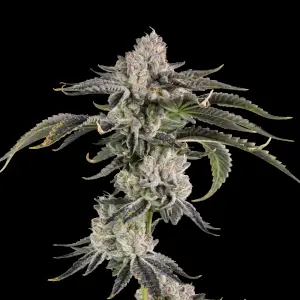


Information on Hash Strainer
Hash Strainer is Philosopher Seeds' proposal for those who work with resin: a feminized and balanced hybrid born from the cross between GMO Rootbeer x Nicole. In tests, a 7% return on extraction has been measured, it flowers in 70 days and smells of gas and sweet spices, with a background of red fruit. It's designed for extraction lovers, for those who care more about what is obtained from the plant than the grams of flower.
Hash Strainer Genetics (GMO Rootbeer x Nicole)
A clone of GMO Rootbeer selected in Mendocino was used as the mother, a Californian genetic linked to Skunktek and Mean Gene from Mendocino (Freeborn Selections) that emerges from combining GMO Cookies with Root Beer. It contributes the most penetrating side of the cross, with garlic, gasoline, earth and spices, nuanced by a creamy sweetness reminiscent of vanilla.
For pollen, a reversed female of Nicole from Marimberos was used, so that all offspring would be feminized. In its lineage are MK Ultra, Blue Satellite, Shishkaberry and Blueberry, and from there come the dense flowers, abundant resin and a fruity register of raspberry, grape and forest berries.
The parents have their own histories. The cross of Chemdawg D with GSC Forum Cut that gave rise to GMO is attributed to Mamiko Seeds, a seed bank based in Spain, although Skunkmasterflex is also cited as the discoverer of one of its best-known cuts.
Nicole, for its part, is the basis of Nicole Kush, the first official release of the Marimberos collective together with DNA Genetics, and according to Seedfinder it won first place in the coffeeshop category of the IC 420 Growers Cup in 2015. Among its ancestors, MK Ultra was born at T.H. Seeds by crossing an OG Kush from JoshD Farms, in Los Angeles, with a G13 male from Barney's Farm, in Amsterdam, and its founder presented it as the first European cross with an American OG Kush. Shishkaberry, in turn, came from joining DJ Short's Blueberry with an Afghani.
Hash Strainer Cultivation
Its base is an exact distribution, 50% indica and 50% sativa, although when evaluating the offspring, a slight sativa air has been noticed in the shape of the buds. This is an uncommon trait among current resin varieties, which usually favor flowers with clearly indica structure, and it should be seen as a detail of the flower and not as a sign of a sativa plant overall.
The observed cycle is 70 days, about 10 weeks. Flower production is 400-500 g/m² indoors, which can vary with phenotype and growing conditions. Its appeal lies in the resin, not in the harvest weight.
Resin and Extraction
This is the reason for the cross. Tests yielded a 7% return on extraction, a measured figure and not an assumption based on the parents' reputation. Even so, it's a reference and not a promise: the result depends on the starting material, cultivation, test conditions and method, whether ice water, dry sift or rosin press.
Aroma and Potency
The profile is based on gas, earth and sweet spices, with red fruits in the background and a creamy texture. It's a contrast that gains a lot in concentrates. Being a new variety, its definitive aroma and terpene profile are yet to be characterized, so it's normal to see differences between phenotypes. There is no cannabinoid analysis yet, although based on the potency of the parents, high THC is estimated, between 20 and 25%.
Questions and answers
Hash Strainer related products (Philosopher Seeds)